

Published in PNAS Nexus (2026) · doi:10.1093/pnasnexus/pgag309

Catalytically Aware & Mutation-Resolved Enzyme Kinetics Prediction

CatRange accurately predicts kinetic ranges for kcat (turnover frequency) and KM (substrate affinity) from enzyme sequences and substrate SMILES — pre-screened with contrastive learning enzyme annotation (CLEAN) and calibrated across wild-type and mutation regimes.

A collaboration between

University of Nebraska–Lincoln Iowa State University University of South Florida
Checking server…

Checking whether the prediction service can accept a job.

Compute resources by the National Research Platform (NRP). You can also run CatRange in Google Colab.

Automating a workflow? API & Documentation.

Submit Prediction Job

Enter sequences and substrate SMILES to initiate the CLEAN validation and kinetics pipeline.

Add up to 10 enzyme–substrate pairs, one numbered card per pair.

Keep each enzyme and its substrate together. Long text wraps inside its box; use Add pair for another pair. Optional names and IDs label the results; they do not retrieve sequences or substrates.

CatRange computes both kinetic values simultaneously — select which to display in your results table.

Checking email notification availability…

CPU is recommended. Auto falls back to CPU when GPU is unavailable.

CPU and memory resources are allocated automatically for your request.

By default, CLEAN screens each sequence before kinetic prediction. Input validation applies to every mode.

CatRange checks for matching saved predictions first. If a match is available for the current model version and screening mode, it reuses those results and labels them as cached.

Find a job

Recent jobs in this browser

Only jobs opened or submitted in this browser are listed. Use a saved job ID, email code, or link to find a job from another browser. Completed entries disappear when their scheduled retention period ends.

No recent jobs saved in this browser.

    CatRange reframes kinetic prediction from exact numerical regression into classification over log10-spaced bins for catalytic turnover (kcat) and substrate affinity (KM), matching the order-of-magnitude scale at which experimental enzyme kinetic measurements are commonly interpreted.

    This biologically grounded formulation mitigates assay-level variability while preserving distinctions among functional catalytic and binding states. The model shows robust order-of-magnitude recovery with class-balanced discrimination and captures mutation-induced movement across kinetic regimes, including losses associated with perturbation of annotated catalytic residues.

    Integrated Workflow

    CLEAN Pre-Screening & Kinetics Pipeline

    How input sequences are checked and processed before kinetics modeling.

    Step 1

    Protein Input

    Enzyme sequence (wild-type or variant) and substrate SMILES entered by user.

    →
    Step 2: CLEAN Screening

    Enzyme Verification

    Contrastive learning predicts top EC number and confidence score to gate genuine enzymes.

    →
    Step 3: CatRange

    Kinetic Regimes

    Predicts calibrated order-of-magnitude ranges for kcat and KM parameters.

    🧬
    Likely EC Number: Predicts the enzyme commission number (EC) via contrastive representation embeddings.
    🎯
    Confidence Score: Reports metric confidence for top EC assignment, flagging ambiguous sequences.
    🛡️
    Non-Enzyme Gating: Automatically filters out non-functional or non-enzyme sequences before kinetics inference.
    Model Lineage

    Evolution of this Work

    Progressing from binary classification to calibrated kinetic parameter regimes.

    2025 Milestone · Predecessor

    RealKcat (Binary Classification)

    Introduced catalytic site alanine perturbations (~17,000 variants) to train models to distinguish active enzymes from broken variants (Cluster 0) in a binary on/off formulation.

    Paper ↗ · GitHub ↗ · CatLog-27k / KinHub-27k ↗

    2026 Published · Current

    CatRange (Calibrated Regimes)

    Overcomes binary limitations by predicting granular kinetic regimes for kcat and KM. Calibrated with 5,278 catalytic variants and 22 experimental anchor pairs.

    Paper ↗ · GitHub ↗ · CatLog (Agentic AI) ↗

    Note on Legacy Binary Mode: To explore the Binary Over-Simplified mode for comparison only, use the Colab notebook. The hosted server runs the primary Mechanistic Mutation-Aware calibrated model.
    Collaboration

    Collaborating Laboratories & Developers

    A joint initiative across three universities combining systems biology, molecular biology and machine learning.

    Academic Attribution

    How to Cite

    CatRange (PNAS Nexus, 2026) doi:10.1093/pnasnexus/pgag309

    Sajeevan KA, Osinuga A, Arunraj B, Ferdous S, Shahreen N, Noor MS, Koneru S, Santos-Correa LM, Salehi R, Chowdhury NB, Aryee R, Calderon-Lopez B, Dey S, Mali A, Saha R, Chowdhury R. CatRange enables robust prediction of enzyme variant kinetic regimes. PNAS Nexus, 2026, pgag309. https://doi.org/10.1093/pnasnexus/pgag309

    For work building specifically on the predecessor binary classification formulation:
    Anna Sajeevan K, Osinuga A, et al. Robust Prediction of Enzyme Variant Kinetic Ranges with RealKcat. bioRxiv [Preprint], 2025.
    Note on Legacy Binary Mode: To explore the Binary Over-Simplified (poor and optional) legacy simplified mode for comparison only, use the Google Colab notebook under the mutation_mode setting.
    Foundation Dataset

    CatLog / KinHub-27k: The Curated Kinetics Corpus ↗

    The empirical backbone for both model generations is a curated corpus of wild-type, mutated, and synthetically inactive sequence–substrate pairs validated against UniProt and PDB structural annotations. CatLog-27k is a human-in-the-loop, AI-agent trustworthy dataset of 27,176 in vitro enzyme–substrate kinetic records created by a systematic audit and correction of BRENDA and SABIO-RK. All mutant entries are manually reconciled against 2,158 source articles.

    2025 Milestone · RealKcat

    Step 1: Teaching Models What "Catalytically Broken" Looks Like

    The predecessor architecture formulated enzyme kinetics screening as a binary active/inactive classification problem. To make models sensitive to catalytic mutations, known catalytic residues were replaced with alanine to create a designated "Cluster 0" of inactivated enzymes.

    ~5,000 initial catalytic-knockout variants Expanded to ~17,000 via InterPro annotations

    Paper ↗ · GitHub ↗ · CatLog-27k / KinHub-27k ↗

    2026 Breakthrough · Published in PNAS Nexus

    Step 2: Calibrated Kinetic Parameter Regimes (CatRange)

    CatRange moves beyond binary classification by directly predicting granular, order-of-magnitude kinetic regimes for kcat and KM. CatRange reframes kinetic prediction from exact numerical regression into classification over log10-spaced bins for catalytic turnover (kcat) and substrate affinity (KM), matching the order-of-magnitude scale at which experimental enzyme kinetic measurements are commonly interpreted. This biologically grounded formulation mitigates assay-level variability while preserving distinctions among functional catalytic and binding states. CatRange integrates 5,278 catalytic-alanine variants calibrated against 22 experimental wild-type-versus-mutant anchor measurements held strictly below a ≤60% sequence similarity threshold.

    5,278 calibrated variants 22 experimental anchor pairs ≤60% similarity threshold

    Paper ↗ · GitHub ↗ · CatLog ↗

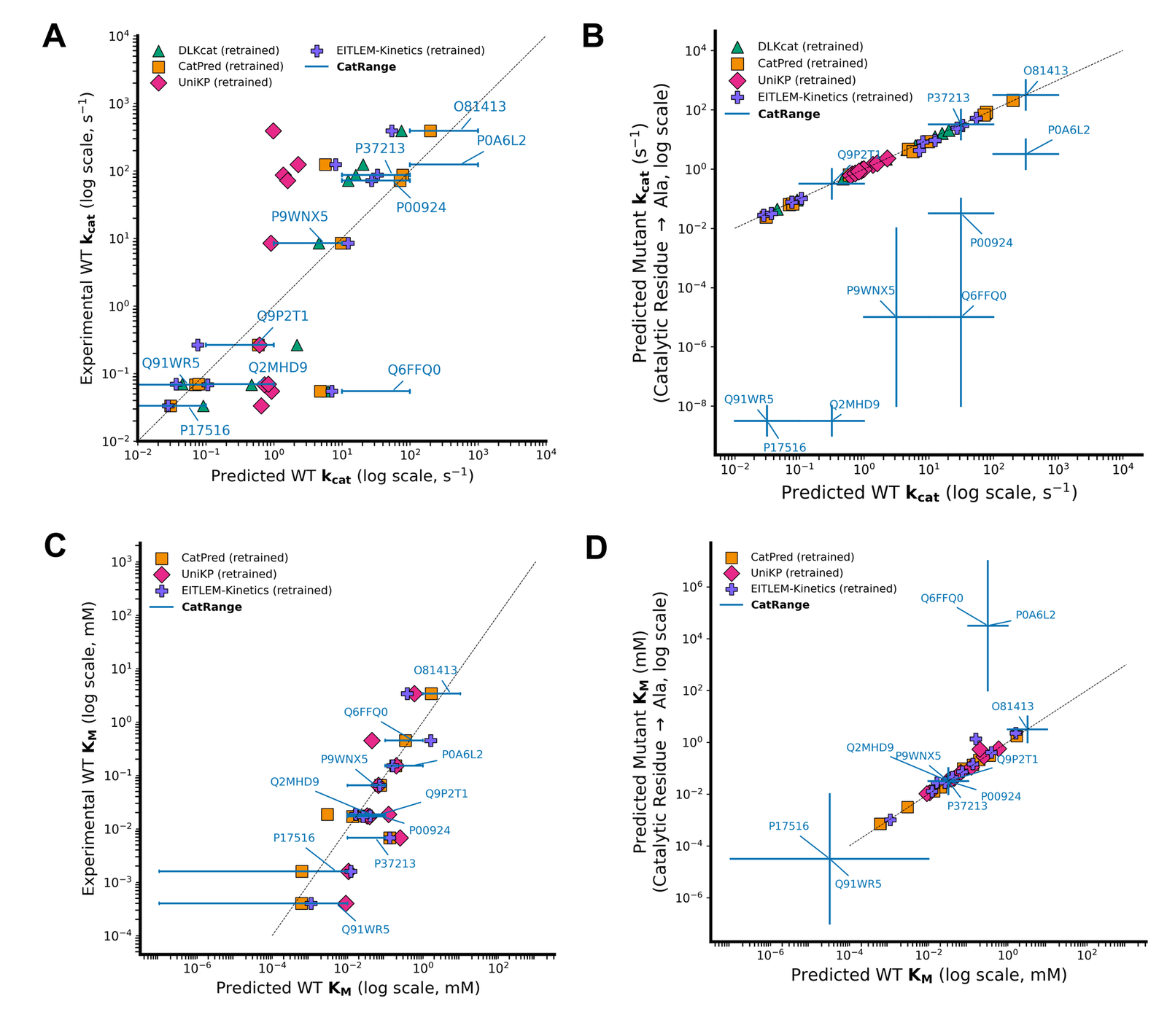
    Four-panel benchmark comparing predicted vs experimental kcat and KM
    Empirical Performance: For real catalytic-residue-to-alanine variants, CatRange accurately recovers the multi-order drop in turnover frequency (kcat) and affinity shifts (KM).
    Next Generation · Agentic AI

    Step 3: Agentic AI for CatLog

    Developed solely by the Chowdhury Lab, agentic AI frameworks are being developed to further enhance data curation (like the CatLog corpus) and predictive capabilities, driving the next phase of metabolic engineering tools.

    CatLog Database ↗

    Job Tracking

    Job: Fetching…

    Connecting…
    1
    Submitted
    2
    Prediction Queue
    3
    CLEAN Screening
    4
    CatRange Kinetics

    Submitting your prediction…

    Queue Time

    Unavailable

    Time waited before processing began

    Compute Time

    Unavailable

    Active processing time on server

    Timing will appear when the server reports it.

    Automatic deletion is scheduled 7 days after the job finishes. Storage and availability are not guaranteed; inputs and results may be lost or become unavailable earlier, including during those 7 days. Download results promptly and keep your own copies. To the extent permitted by applicable law, CatRange and its operators are not liable for loss of submitted data or generated results.